

If you are interested for 2025 program write to us at filminstitute@auroville.org
1 YEAR PG DIPLOMA IN DOCUMENTARY ARTS
Title: OPEN SPACE DOCUMENTARY ARTS PROGRAMME
Starting : March 2024
Modality: Multi-site programme incorporating experiential learning modules in Auroville-Pondicherry and Ladakh. Multidisciplinary, multimodal, dynamically designed, integrative, interactive and application-oriented programme.
OVERVIEW:
In an increasingly warring world within and around, instead of reconciling with the opposing principle, we are evidently splitting, denying, denigrating and devastating the other. As artists and mediators, we wonder what is our function; our grasp of facts, fiction and everything in between. The word ‘documentary’ is often burdened with the idea of ‘truth’. However, what is ‘truth’ – for whom – who vehemently insists upon it – who contests it – why – how does it matter – what to do?
Open Space Documentary Arts Programme finds its relevance in the proliferating new media environment, where the form and function of a so-called documentary is evolving out of its well-organized and channelised framework of production and distribution into much more dynamic, spontaneous sprouting from unforeseen spaces, uninhibited, empowering, accessible and authentic; be it immediate, interior and imaginative or extending into the unfolding events of the world.
Anchored in this philosophical and integral approach, the programme offers hands-on training through extensive inputs, interactions and exercises, experiential journeys calling for introspection and observation, abstract conceptualization, active experimentation and creative expression with one’s chosen subject, site and style.
Auroville, an international city, the city of the future, off the Coromandel Coast in South India contrasting with Ladakh, the trans-Himalayan high altitude desert at the Northern frontier, provides a spectrum of spatialities and temporalities. The geo-ecological, the biodiverse, the archaeological, historical, political, socio-cultural and magico-mythical multiverses open up, stimulating new imaginations, cultivating connections, circulating ideas and enabling scholarly and artistic interpretations.
Rather than mainstream, the programme offers a multi-stream approach, attempting to push the boundaries, cross the borders, bridge the gaps and thus, empower storytellers from a more expansive territory.
Visual research and production of media artefacts such as photo and video essays, soundscapes, video art installations, archival curations and creative documentaries are expected tangible outcomes.
CURRICULUM & SCHEDULE DETAILS:
The programme will unfold in 5 modules – progressively – as follows:
Module-1: 10 weeks: In Auroville: Mar-Apr-May 2024
Module-2: 10 weeks: In Ladakh: May-Jun-Jul 2024
Module-3: 06 weeks: In Auroville: Aug-Sept 2024
Module-4: 10 weeks: Site of Choice + Home Site: Oct-Nov-Dec 2024
Module-5: 06 weeks: Production Site + Auroville: Jan- Feb 2025
The modules altogether will engage in approximately 1500 hours of coursework. These are geared towards production of films and other media artefacts through (i) inputs and interactions (ii) exercises and applications (iii) assessments and exhibitions – to be worked out individually as well as in groups.
This being a site-centric discourse, the understanding of sites will go hand-in-hand with the understanding of the cinematic art and craft.
1st Module – 10 weeks – In Auroville:
1. Landscape Orientation : Auroville and the Bioregion (i) Field visits (ii) Interactions
2. Orientation of Cinematic Arts – with special focus on Documentary
-Basics of Media and Cinema Studies;
-Basics of Documentary : Documentary & Fiction;
-History of Documentary & the Contemporary Documentary Practice;
-Exploring the Documentary Practice in relation to: (i) New Media (ii) Visual Anthropology and Ethnography (iii) Audiovisual Documentation & Archiving (iv) Communication Design & Advertising (v) Poetry & Auteurship (vi) Activism.
3. Visual Research : Fundamentals and Methodologies
4. Skill Development: Writing, Photography; Cinematography; Sound Recording & Editing Basics
5. Philosophical Focus: (i) Politics & Poetics of Film-making (ii) Self Reflexivity
2nd Module – 10 weeks – In Ladakh:
1. Landscape Orientation : Ladakh and Kargil: (i) Field Visits & Excursions (ii) Conferences
2. Real Sites to Cinematic Spaces: Exploring actualities of the site/s – translating them into language of cinema; immersing in the landscape and experimenting with narrative tools & techniques of cinematic articulation.
3. Skill Development: critical engagement with subject and site; research and reconnaissance; imagination and ideation; connection and conceptualization; production planning; photography; cinematography; sound and edit.
4. Productions of Media artefacts – Photo essays; Video essays; Soundscapes and Portrait Films.
5. Philosophical Focus: (i) Politics & Poetics of film and media practice (ii) Self Reflexivity
3rd Module – 6 weeks – In Auroville:
1. Assessment: of Media Artefacts generated during Module 1 & 2;
2. In-depth analysis of filmed realities: (footage) connecting, contextualizing and comprehending the fragments vis-a-vis possibilities of the whole.
3. Archival Research and Interpretation: Understanding the principles and practice of audiovisual archiving; engaging with the archival material in context of cinematic potential.
4. Editing Intensive: Study of Temporality, Layered Narratives and Conceptual Moorings from Rushes through an intensive editing workshop.
5. Final Project Conceptualization & Pitch Development: Ideating Diploma Project (final project) and pre-production routine.
4th Module – 10 weeks – Site of Choice:
1. Pitch Development and Production Plan: Pitching project and production plan for approval.
2. Production: Approved Pitches go for Production – Filming.
3. Post Production: Editing and Sound Design
4. Strategizing Distribution: strategizing forward linkages of the project.
5. Digital Gallery : Initiate construction of Digital Gallery / Website to upload and exhibit selected media artefacts produced during the course.
5th Module – 6 weeks – Site of Production + Auroville:
1. Mastering: Finalizing and Mastering the final project
2. Digital Gallery : continued.
3. Assessments: Viva and Production Assessments
4. Public Screenings at the production site– revisiting sites and screening with subjects.
5. Final Exhibition & Valedictory Function: in Auroville for 1 week.
Study Materials; Read and Watch Lists will be provided at the beginning of each module.
STUDENT PROFILE:
The programme aims to draw national and international students, having diverse professional backgrounds and interests including: film, art, architecture and design; anthropology and other social sciences. The trans-cultural-disciplinary participation aims at a productive exchange of ideas and insights setting up a diversity and inclusive experience of collective learning. Regional admissions from Auroville bioregion and Ladakh are encouraged.
BASIC QUALIFICATION & SELECTION PROCESS:
The students for this programme will be selected via a 2-tier selection process:
Step 1 – Applications will be shortlisted on the basis of 2 main factors:
(i) Up to 250 words statement of Purpose / motivation to join the programme.
(ii) General Orientation -not necessarily related to filmmaking; but reflecting specific interests.
Step 2 – Online Interview with Shortlisted Applicants.
Final Selected Applicants will be guided to Ladakh University Portal for payment of fees and registration of admission.
Please note: This is a Post Graduate Diploma Course. Thus, selected applicants who submit verified degree certificates (10+2+3 Certificates)- will receive PG Diploma. Those who are not formal graduates will receive ‘Certificate of Participation’. The course participation will be the same for both categories, irrespective of the certification.
Minimum age required to participate in the programme is 18+. No upper age limit.
FEES:
For Indian Students : ₹1,50,000/- tuition fee + ₹15,000/- admission fee.
For International Students: € 3250/- tuition fee + € 250/- admission fee.
The fee includes applicable taxes.
The fee does not include accommodation. Accommodation charges will be approximately ₹6000-8000 / €150 per month in Ladakh and Auroville. Guest Houses in Auroville and Homestays in Ladakh will be facilitated on twin sharing basis. Those preferring single occupancy can opt for it at a premium. Meals can be opted locally – at basic rates on daily / monthly subscriptions.
INFRASTRUCTURE:
This being a site-centric course, prime emphasis will be exposure to a range of sites and facilitating extensive field-work; also facilitating interaction and integration with the local communities. Mobility during organized field visits will be taken care of in Auroville as well as Ladakh. However, mobility required for individual and smaller group exercises is expected to be worked out by respective individuals/groups.
A local study station / base camp / classroom – will be available, well equipped with screening facilities. Conference Halls and Auditorium will be available as and when needed in the schedule.
Auroville Library and Ladakh University Library can be accessed by Students.
EQUIPMENT:
Students are expected to have their own basic equipment: (i) Camera (ii) Tripod (iii) Sound Recording Device (iv) Editing Laptop. Additional gears are an advantage – however not compulsory. No specific recommendations for the camera models. The editing machine however, should be capable enough to process footage shot from one’s own camera, whichever camera one may have. Those willing to purchase new equipment specifically for this programme may consult us.
Auroville Film Institute will have equipment sets; they will be used for demonstrations; they can be issued to the students as back up on special requests – as and when required.
FACULTY & COURSE DIRECTION:
The course is conceptualized and curated by Richa Hushing and will be directed by 3 main faculty members from Auroville Film Institute: Debkamal Ganguly and Rrivu Laha along with Richa Hushing. The 3 main faculty will be responsible for overall unity of the discourse including input & orientation sessions, exercises & applications, production mentorship, reviews & assessments and study materials. Please find annexed the profiles of the main faculty.
The course will have an additional faculty pool – made up of other consultant filmmakers, scholars and a range of subject and site specialists – who will visit in-person as well as online.
CERTIFICATION:
Post Graduate Diploma will be issued by University of Ladakh in association with Auroville Film Institute. Certificate of Participation (for those who are not formal graduates) too will be issued jointly by UoL and AVFI.
QUERIES:
For further details and queries, reach out to:
Richa Hushing +91 9969879319 /filminstitute@auroville.org.in and
Tsultim Zangmo at + 91 9797067266 / t.zangmo2009@gmail.com
LIMITED SEATS
Visit the University of Ladakh website here.
MAIN FACULTY PROFILES:

Debkamal Ganguly:an alumnus (1996-1999) from Satyajit Ray Film and Television Institute, Kolkata, is an independent filmmaker, researcher and teacher of cinematic arts. He has taught for 08 years (2012-2020) in Film and Television Institute of India, Pune, in the departments of Editing, Direction and Screenplay Writing; he took active part in curriculum design, implementation of Choice-based Credit System (CBCS) and getting approval of masters level equivalence for the film wing courses from Association of Indian Universities (AIU). He has taught as guest faculty in National Institute of Design (NID), Ahmedabad, Flame University, Pune, School of Film and Media Sciences, Kalinga Institute of Industrial Technology (KIIT), Bhubaneswar. He has worked as Syllabus Committee Member at Satyajit Ray Film and Television Institute (SRFTI), Kolkata, and Member of Board of Studies for KIIT Bhubaneswar. He is associated with Auroville Film Institute since 2021, offering specially designed courses on short films, documentary, analysis of works of master filmmakers, film-philosophy, cinema and classical arts, spatial and temporal concepts of cinema, appreciation of editing. His independent creative video work got published under special curator-ship from Lowave, Paris. Video art has been featured in the exhibition ‘Indian Highway’ and showcased in galleries of various cities of Europe and Asia. Video and film works have received recognition, including ‘Tiger Award for Shorts’ in Rotterdam (2007), Special Jury Award for Non-fiction in Indian National Film Awards (2019) He has presented papers on themes related to cinema studies, media studies, film-philosophy, pedagogy of cinema, immersive sound, visual art, intertextuality, collective memory, literature, craft traditions at CARA-CIECT conference in Witwatersrand University, Johannesburg (2018), CILECT conference in VGIK, Moscow (2019), Lithuanian Academy of Music and Theater (2019), University of Arts, Stockholm (2022), Sapientia University, Romania (2022, 2023). His research based essays got published in several academic journals and anthologies including publication from Routledge (2022). He is a participant & coordinator of India in an international project for artistic research involving BRICS countries (2018). He has received filmmaking, artistic and research grants from Films Division, Mumbai (2022), Indian Foundation for the Arts (IFA), Bangalore (2020), Center for the Studies of Developing Societies (CSDS), New Delhi (2006, 2004), National Film Archive of India (NFAI), Pune (2004).
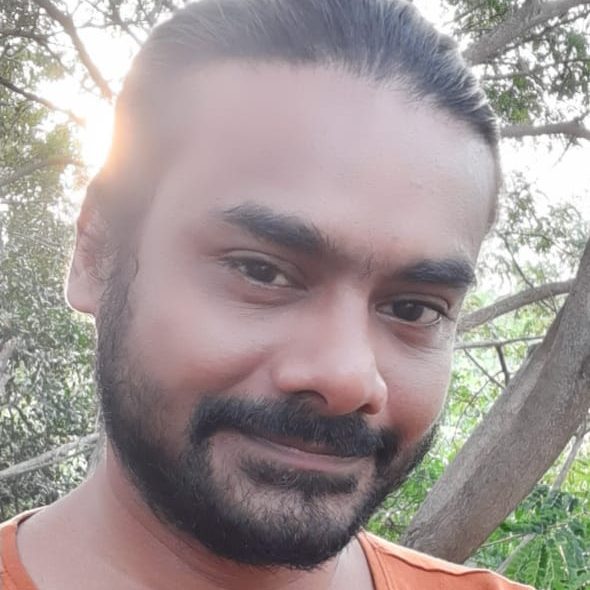
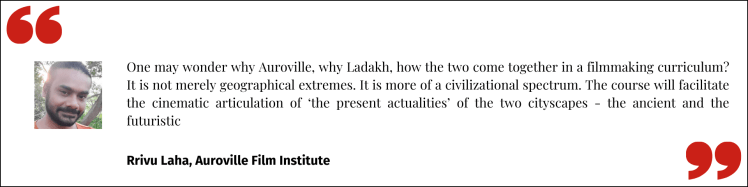
Rrivu Laha: graduated from St. Xaviers College Calcutta in Mass Communication and Video Production (2003); he did PG diploma in Motion Picture Cinematography from Film and Television Institute of India, Pune (2007). His documentary filmography began with student film ‘Aamchi Kasauti’ (2006) winning Best Documentary at IBDA Dubai and at Jeevika Film Festival of Livelihoods; selected in Mumbai International Film Festival and Tehran International Film Festival (2006). ‘Vasudev, the singing minstrels of Maharashtra (2007) won Special Jury Mention at Youth New Wave, Sri Lanka; ‘Dhananjay Kulkarni ‘Chandragupt (2009) won a ‘Special Jury Mention’ at Jeevika International Film Festival Film Festival (2011) and showcased in the Retrospective of Indian Documentaries – Iran International Documentary Film Festival (2013). As a Cinematographer, his work began with ‘Thread’ that showcased in 64th Locarno International Film Festival and Clermont-Ferrand Film Festival among others. He has worked as DoP for short films, ads and documentaries. As a film and media practitioner, critical media pedagogy has been Rrivu’s chief preoccupations. He has actively sought to contextualize and contemporise his cinematographic practice in a rapidly evolving media environment. His interest in media for education brought to his repertoire, his role as a Creative Producer of educational projects: ‘1000 science activity videos for IL&FS Education Technology’ (2011-13) ‘Audiovisual Training Modules’ for various silvicultural and forestry practices (2013-16); other technology interventions, public service spots and process documentation projects. Post his stint in the Nicobar Group of Islands as associate director and cinematographer for a documentary ‘Nicobar, a long way…’(2017), Rrivu moved to Auroville with his partner, Richa Hushing. He envisioned and co-executed ‘Auroville Timelines’ an in-situ video art project, born out of research of Auroville’s archival footage (2017-19). In 2019 Rrivu co-founded Auroville Film Institute to experiment with a new pedagogy, encouraging new practices in cinematic arts. He has directed Hands On Documentary Film Workshops in Ladakh, Rann of Kutch and in Auroville along with his collaborator, Richa Hushing.

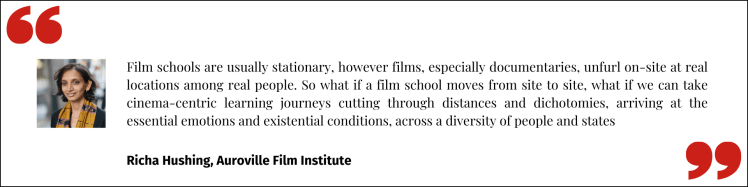
Richa Hushing: Alumna of Film and Television Institute of India (TV Direction 2005), Richa Hushing began her work with Majlis, an interdisciplinary, multi-formats art initiative in Bombay, where she joined ‘Godaam’, a storehouse of documentary film footage. She was an assistant to the expansion of ‘Godaam’ into a greater entity: pad.ma – Public Access Digital Media Archive, an online repository of densely text-annotated video material, primarily footage. It was her tryst with this ‘time’ that did not find space in film, but was still no less telling, that crafted her subsequent practice as an audiovisual archivist, an editor and a documentary filmmaker. Between 2006-08 Richa helmed the ‘The Dharavi Documentation Project’ filming character portraits and communities during one of the most volatile phases of redevelopment. Her portrait film ‘Director Painter Shri Baburao Laad Saheb’ running 5 star acting school in Dharavi got showcased in Retrospective of Indian Documentaries – Iran International Documentary Film Festival, 2013 – among others. In 2014 she won the Maharashtra State Award for her film ‘Devrai -the Sacred Groves’. ‘Nicobar, a long way…’ (2017), observing aboriginal islanders’ identity and resilience in wake of Tsunami received accolades in international anthropological and environmental film festivals: Ethnografilm Festival, Paris; Royal Anthropological Film Festival, Bristol; World Film Festival, Estonia; Viscult – The festival of Visual Culture, Finland; Film South Asia, Nepal; Smaragdni Eco Film Festival, Croatia; Pêcheurs du monde, France; and a special mention award at the Millennium Film Festival, Brussels. After a decade-long practice based in Mumbai, she and her partner Rrivu Laha moved to Auroville, an international township (2017) and founded the Auroville Film Institute (2019). Richa works as Creative Director and Curriculum Designer, curating and conducting cinema-centric learning journeys in an experimental modality. Currently she is also making a biographical film on Padma Shri Awarded archaeologist, K K Muhammed – for NFDC.
Get our latest posts in your inbox –
 Auroville Film Institute
4 thoughts on “Open Space Documentary Arts”