
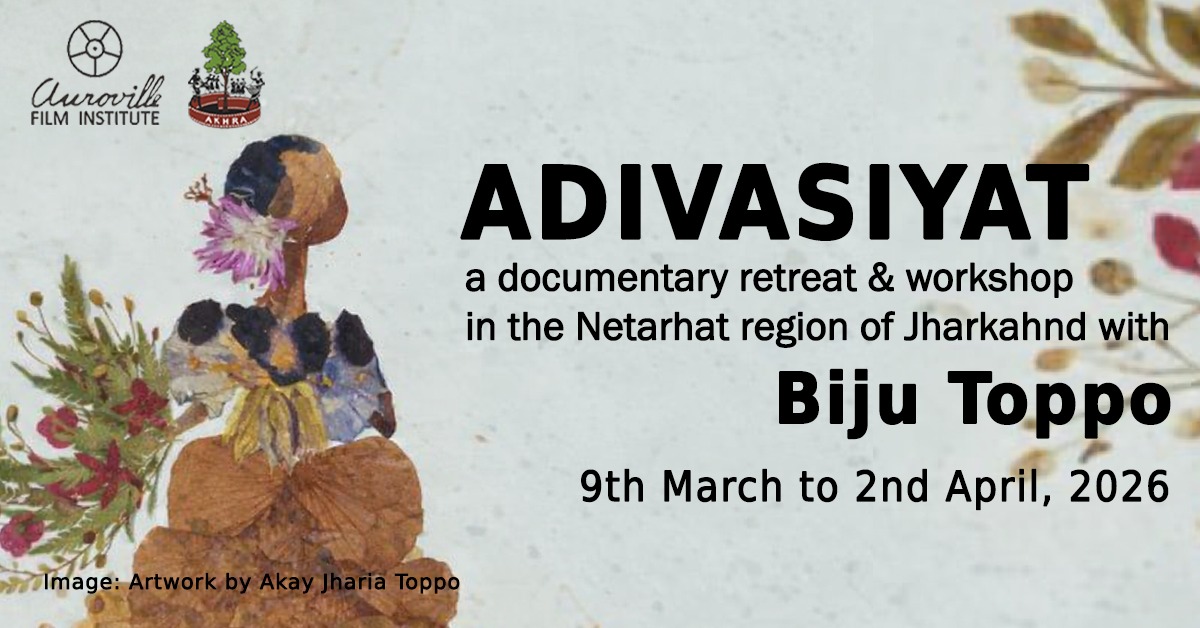
24 days Documentary retreat & workshop with Biju Toppo
From 9th March to 2nd April 2026
This workshop is a part of Open Space Documentary Arts Programme.
in collaboration with local and logistical partners Akhra, Ranchi and VDoc.
WORKSHOP OVERVIEW:
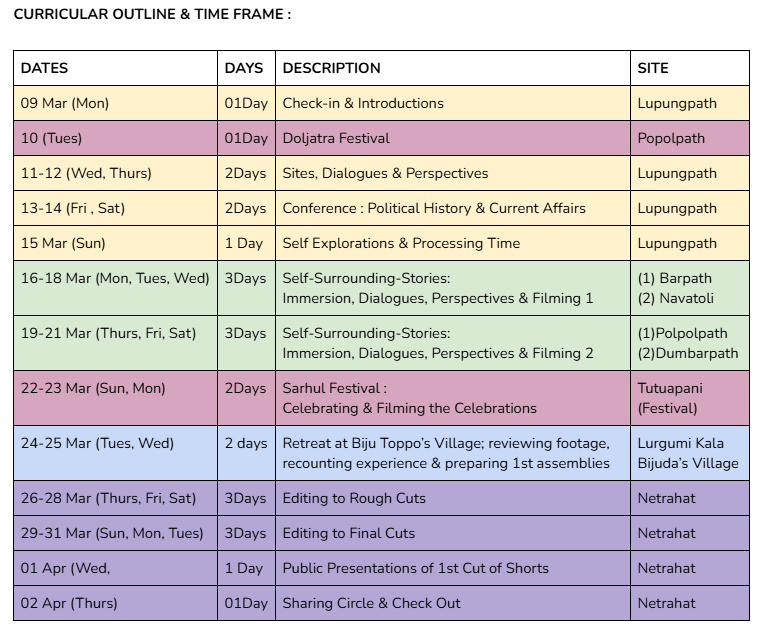
Join us starting Deul / Doljatra with people of Polpolpath;
As the Sal forests turn from dry brown to vibrant green, their white blossoms carpeting the earth like soft snow;
as the Palash erupts into clusters of blazing orange-red;
as Kachnar draws butterflies and sunbirds into its gentle bloom;
and as Mahua fills the air with its intoxicating fragrance, calling people, animals, and birds alike to its sweet fallen flowers;
as the Adivasis of Jharkhand, the Oraon (Kurukh), Asur, Birjia, Binjhia, Munda, Santhal, Lohra, and other tribal communities prepare for Sarhul, the sacred marriage of the Sun and the Earth;
as they gather at the Sarna of Tutwa Pani to pledge their unity with, and their struggle for, Jal, Jangal, and Jameen (water, forests, and land) on the occasion of Sankalp Divas (Pledge day) of Netarhat Movement;
Come gather in song and dance, in the rhythm of the Madal (drum) and the melody of the Bansuri (flute), and renew the collective pledge for the continuity of our Adivasiyat , the living traditions, languages, and deep ecological wisdom of our peoples.
You are warmly invited to join the rituals of communion with nature alongside the communities of Netarhat, Polpolpath, Lupungpath, Barpath, Navatoli, Dumbarpath, Lurgumi Kala, and Pakripath, and to participate in a 24 days documentary retreat and workshop with Biju Toppo, acclaimed people’s filmmaker from the land of Netarhat.
Participants will engage in collective inquiry around the following themes:
* The significance of cinema in everyday life: as cultural, social, and political practice.
* Adivasis in cinema: questions of representation, invisibility, stereotyping, and authorship.
* Adivasis through the camera’s gaze: perspective, power, ethics, and positionality.
* The importance of regional cinema in sustaining local languages, cultures, and lived realities.
* World cinema and us: dialogue between global traditions and local contexts.
* The role of local, rooted stories in shaping meaningful cinema.
* Developing narrative voice, script processes, cinematic structure, and treatment grounded in lived contexts.
to be explored through Conversations, Screenings, Field observation, Community interaction, Collective reflection & Filmmaking practice.
Sites of residency:
Netarhat, Polpolpath, Lupungpath, Barpath, Navatoli, Dumbarpath, Lurgumi Kala, and Pakripath.
WHO IS IT FOR:
Filmmakers, photographers, journalists, writers, researchers, historians, educators, activists, artists, Adivasi youth, community storytellers, and all those engaged with questions of land, culture, memory, and people’s narratives.
SELECTION
Motivation letter / statement of purpose will be considered while selecting participants.
EQUIPMENT:
Participants are expected to have their own basic equipment: (i) Camera (ii) Tripod (iii) Sound Recording Device (iv) Editing Laptop. Additional gears are an advantage – however not compulsory. No specific recommendations for the camera models. The editing machine however, should be capable enough to process footage shot from one’s own camera, whichever camera one may have. AVFI will have equipment sets; they will be used for demonstrations; they can be issued to the participants for collective use – as and when required.
WORKSHOP DIRECTION:
The workshop will be directed by Biju Toppo. Several other interdisciplinary field experts will join the workshop as guides.
CONTRIBUTION:
INR 38000 – For Indian Participants (from Outside of the Netarhat Region)
INR 20000 – For Indian Participants (from within of the Netarhat Region) Conditions Apply
€ 750 – For International Participants (from outside of SAARC)
€ 375 – For International Participants (from within SAARC)
*Participation Contribution includes essential mobility, shared accommodation and meals expenses in village homes on site for 24 days.
MENTOR PROFILE
Biju Toppo is one of India’s most respected Adivasi filmmakers and a pioneer of indigenous cinema, known for using film to challenge dominant media misrepresentations and foreground community-rooted perspectives. A co-founder of Akhra, a documentary film collective based in Ranchi, Jharkhand, he has documented the lived experiences, cultural resistance, and political realities of Adivasi and rural communities since the mid-1990s.
Over a career spanning more than three decades, he has worked as a director, producer, cinematographer, editor, and mentor. His films—including Iron Is Hot, Naachi Se Baanchi, The Hunt, and Kora Rajee—are widely studied for their ethical engagement with questions of land rights, environmental justice, displacement, identity, and people’s movements.
In recent work, he served as co-producer on Humans in the Loop (dir. Aranya Sahay).
Toppo also teaches video production and media practice at St. Xavier’s College, Ranchi.
Local Experts & facilitators (will be updated upon confirmation)
Meghnath (29 June 1953)- is a activist working in Jharkhand for last 30 years. He has been with the people’s struggle against destructive development. As a film maker he has tried to document the voice of those sections of people who remain unheard. Meghnath was awarded prestigious National Film Award in 58th & 65th National Award.
Ranendra (b. 1960) is a Hindi writer, critic, and civil servant from Jharkhand, known for his engagement with Adivasi life, displacement, and identity. His acclaimed novel Global Gaon Ke Devta examines the impact of globalization on tribal communities. He has edited Panchayati Raj: Hashiye Se Hukumat Tak and the Jharkhand Encyclopedia. His works include Gayab Hota Desh, Raat Baaki Evam Anya Kahaniya, and Thoda Sa Eshtri Hona Chahta Hoon. He has also served as Director of the Ram Dayal Munda Tribal Research Institute, contributing to research and promotion of tribal culture.
Niranjan K. Kujur is a filmmaker and graduate of the Satyajit Ray Film and Television Institute (SRFTI), Kolkata. A multilingual director, he works across Kudukh, Santhali, Bengali, Hindi and Mandarin. His film Edpa Kana won the National Film Award and screened internationally. His works have featured at IFFI and Busan. He has also directed award-winning brand campaigns and worked on Netflix’s Jamtara.
Seral Murmu is a Santhali filmmaker from Jharkhand who uses cinema to foreground Adivasi life, culture, and socio-political issues. Drawing from indigenous folklore and lived experiences, his films challenge stereotypical portrayals and amplify underrepresented voices. His award-winning short Sondhayni reflects tribal beliefs and environmental ethics. Murmu is committed to building a tribal film movement, using storytelling as a means of cultural preservation and social dialogue.
Co-facilitators
Rrivu Laha is a filmmaker, cinematographer, and media educator. He studied Mass Communication at St. Xavier’s College, Calcutta, and Cinematography at FTII, Pune. His documentaries and cinematography work have screened at major international festivals including Locarno, Clermont-Ferrand, MIFF, and Tehran.
A co-founder of the Auroville Film Institute, Rrivu’s practice focuses on documentary filmmaking, cinematography, and critical media pedagogy. He has led hands-on documentary workshops across Ladakh, the Rann of Kutch, and Auroville, and continues to explore new pedagogies in cinematic arts.
Sanket Ray is a cinematographer, documentary filmmaker, and film educator with over 14 years of experience across film, television, digital media, and education. An alumnus of the Film and Television Institute of India (FTII), Pune, he works primarily in non-fiction cinema, focusing on visually grounded, human-centered storytelling.
His work spans independent documentaries, branded content, and socially engaged films, with collaborations including TATA and Save the Children. Sanket’s films have been screened and awarded at major national and international platforms such as the Sundance Film Festival, San Francisco International Film Festival, Mumbai International Film Festival, and Indo-German Film Week (Berlin).
Before fully transitioning into filmmaking, he worked in journalism and television with Times Now, NewsX, and The Times of India, a background that informs his research-driven and editorially disciplined approach. Alongside professional practice, Sanket is deeply invested in film education and media literacy, having taught and mentored students through the Delhi Government’s Dr. B. R. Ambedkar School of Specialised Excellence, Whistling Woods International, and the Auroville Film Institute.
QUERIES:
For queries, if any, please write to: info@aurovillefilminstitute.com or call / message +91 9969879319 (whatsapp and telegram only)
 Auroville Film Institute