
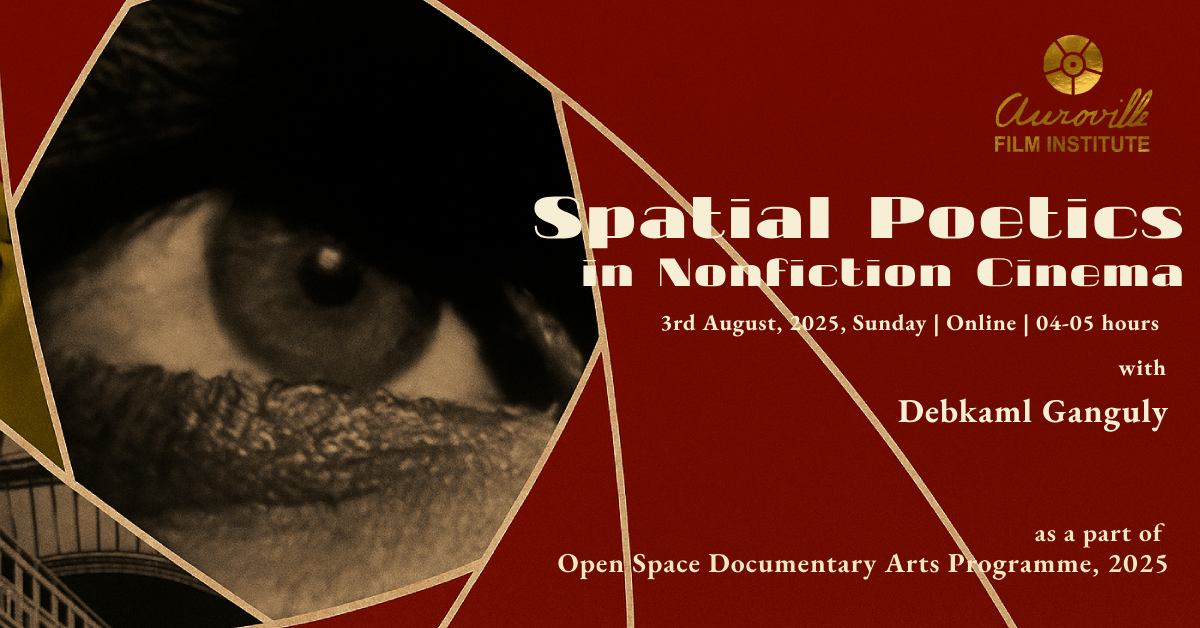
3rd August, 2025, 01 day, 04-05 hours
OVERVIEW:
This intensive online session would explore how cinematic practice can construct, encounter, and transform space, not merely as background, but as an active participant in the nonfictional experience. At the intersection of observation, conceptualisation, cinematographic choices, and the rhythmic textures of editing and sound, this course examines how filmmakers can inhabit and cocreate spatial experiences that are at once personal, political, and sensory.
Rooted in the core praxis of nonfiction, we foreground the interplay between the filmmaker’s coordinates of view, the camera’s gaze, and the space itself, not only as geographical or architectural, but as a living constellation of geological, cultural, anthropocentric and non anthropocentric elements. The question to ponder: how does usual places like a locality, a forest, a ruin, a shoreline, or a market participate in shaping cinematic meaning? How do subjectivities of both filmmaker and participants in front of the camera and at the margins of the frames, alongside the so-called ‘objective’ realities, reconfigure how space is rendered, remembered, or re-imagined?
These cinematic spaces are not neutral, and they do not just belong to the ground of reality to be recorded and rendered. Those are artisanal creations, where works of hand and flows of mind converge. Those carry textures, resistances, silences, and secrets. As the lens dwells, moves, hesitates, or listens, the nature of engagement shifts. It may begin in curiosity, pass through comparison with other similar registers, evolve into analysis and discourse, but soon spirals into zones of memory projection, loss, yearning, and melancholic wonder. The space on screen is not merely observed, it reverberates with what is passing, what has passed, and what can never return in quite the same way. Even the act of documenting gets touched by transience. A room, a road, a voice, a hill, a tree, a figure, a face, once filmed, become shadows of their temporal fullness, holding both presence and absence, like a river into which one cannot step twice.
Through such experiential registers, the course aims to cultivate a sensibility toward space not only as physical extension but as the unfolding of time, memory, mortality, and desire. It encourages an awareness that every filmic frame is haunted by the impossibility of full return, what is captured is always already gone, and yet it glows with a peculiar, aching vitality. This paradox, the impossibility of reliving and the necessity of re-evoking, is the very core of the cinematic encounter in nonfiction.
In the course the participants will be introduced to various modes of observational framing, performative engagement, temporal layering, and spatial montage. The course moves beyond representation to an affective and phenomenological understanding of how space is sensed, traced, and transformed through the act of filming and editing, not only through apparatus, but primarily through concsiousness, and the appartus being the extension of the same.
MODE OF TEACHING:
In the session, sequences from the film will be shown and discussed in depth.
PARTICIPANT PROFILE :
Participants are welcome who carry a critical and creative urge to relate to the world of documentary and its relation to different aspects and nuances about the reality, we are immersed in.
FACULTY PROFILE:
An alumnus from Satyajit Ray Film and Television Institute (SRFTI), Kolkata, Deb Kamal Ganguly is an independent filmmaker, researcher and teacher of cinematic arts. He has taught for 08 years (2012-2020) and designed curriculum in Film and Television Institute of India (FTII), Pune, in the departments of Film Editing, Film Direction and Screen Studies; and as a guest faculty in National Institute of Design (NID), Ahmedabad, Flame University, Pune, Kalinga Institute of Industrial Technology, Bhubaneswar. Ganguly’s works have been published under special curator-ship from Lowave, Paris; his video art featured in the exhibition ‘Indian Highway’ and showcased in galleries of various cities of Europe and Asia. His films done in the capacity of editor, script-writer and sound designer have been shown in competitive sections of various international festivals and received recognition, including ‘Tiger Award for Shorts’ in Rotterdam (IFFR 2007). Ganguly has presented papers in various international and national seminars and conferences on various themes related to cinema, Deleuze studies, visual art, interfaces of art practices, translation studies, collective memory, Bengal studies, Media studies, pedagogy of cinema, film editing as a discipline, immersive sound etc including CARA-CILECT conference in Witwatersrand University, Johannesburg (2018), CILECT conference in VGIK, Moscow (2019), Lithuanian Academy of Music and Theater (2019). He is a participant of an international project for artistic research involving BRICS countries, being the coordinator for India (2018).
QUERIES:
For queries, if any, please write to: info@aurovillefilminstitute.com or call / message +91 9969879319 (whatsapp and telegram only)
 Auroville Film Institute